We wrote this so you can see how the topic works in practice. You can read it from anywhere. If you want lab practice next, we will help you pick a course in counselling.
Back to Blogs
Featured Article
Artificial Intelligence in Modern Education
December 13, 2025
6 min read

Personalized Learning with AI

AI-driven platforms analyze student performance and learning patterns to create customized study plans. This helps slow learners get additional support while advanced learners move faster.
AI Virtual Tutors

Virtual tutors powered by AI can provide 24/7 assistance to students, answer queries instantly, and offer explanations in different formats such as text, audio, and visuals.
Who this is for
This is for students, job seekers, and working learners who want a clearer picture of the skill before they pick a course.
How we help you after you read
We help you see a career direction before you pick a course. You can start from where you are, including if you are new to IT. In lab we practise the role, not only names of tools. After a course, we stay with you until you get a job, based on your performance.
Share this article
What you can do next
If this topic is the skill you want to practise, we can map it to a course. Visit an Ahmedabad centre with your parents, or join through online admission if you live outside Ahmedabad.
Questions about this article
Short answers about who this is for, what to do next, and how to talk to us.
Who should read Artificial Intelligence in Modern Education?
This is for students, job seekers, and working learners who want a clearer picture of the skill before they pick a course. You can read it from anywhere. If you want lab practice next, we will help you pick a course.
Do I need to visit Ahmedabad to use this article?
No, you can read it from anywhere. If you want to learn with us next, we warmly welcome you and your parents to visit one of our Ahmedabad centres — Maninagar, Nikol, or Vatva. If you live outside Ahmedabad, you can join through online admission with a counselling call.
Is this article the same as joining a CEC course?
No. We wrote this so you can understand the topic in plain language. A course is where you practise in lab, build work, and get feedback.
What should I do after I finish reading?
If this is the skill you want to practise, book counselling or open a related course. For this topic, you can start with Artificial Intelligence & Machine Learning, Data Science & AI Expert with Python, Graphic Designing & UI/UX with AI Tools, or browse all courses.
Can a parent use this to decide for a child?
Yes. You can read it together and then book counselling. School children of any grade start with counselling first — we do not enrol a child into a full career track without that conversation.
Can I start this skill after 10th or 12th if I did not pass?
After 10th or 12th, anyone can apply — pass, not pass, or a gap year, and any stream. Counselling is where we match the skill in this article to a course you can actually attend.
Will reading this get me a job?
No. An article is for understanding. If you join a course, complete practical work, and sit interviews, we stay with you until you get a job, based on your performance.
How do I talk to CEC about this topic?
Book counselling and mention this article, call +91 75740 10176, WhatsApp the same number, or email info@cecyours.org. In Ahmedabad, we would be glad to welcome you and your parents at a centre; outside Ahmedabad, we will set up a counselling call.
More to Explore
View All Articles
Dec 15, 2025
How Artificial Intelligence is Transforming Businesses
Role of Artificial Intelligence in Modern Business
Artificial Intelligence (AI) is rapidly transforming the way businesses operate, compete, and grow. By enabling machines to mimic human intelligence, AI helps organizations automate processes, analyze large volumes of data, and generate actionable insights. Today, AI is no longer a futuristic concept—it is a practical, powerful tool driving innovation across industries.
At Computer Education And Cybernetics, we view AI as a strategic enabler that empowers businesses of all sizes to achieve efficiency, scalability, and smarter decision-making.
What is Artificial Intelligence?
Artificial Intelligence refers to systems and technologies that can perform tasks typically requiring human intelligence. These tasks include learning from data, recognizing patterns, understanding language, making decisions, and solving complex problems.
AI systems rely on technologies such as:
Machine Learning
Natural Language Processing (NLP)
Computer Vision
Predictive Analytics
Together, these capabilities allow businesses to turn raw data into intelligent actions.
How AI is Transforming Business Operations
AI is revolutionizing modern businesses by automating repetitive and time-consuming tasks. This allows employees to focus on higher-value work such as strategy, creativity, and customer engagement.
Key operational benefits include:
Automation of routine processes
Reduced human error
Faster task execution
Improved operational efficiency
From data entry to report generation, AI-driven automation enhances productivity across departments.
AI in Data Analysis and Decision-Making
One of the most powerful applications of AI is its ability to analyze massive datasets in real time. Traditional analysis methods often fail to keep up with the volume and complexity of modern data.
AI enables:
Pattern recognition in large datasets
Predictive analytics for forecasting trends
Real-time insights for faster decisions
Accurate risk assessment
Businesses can make data-driven decisions with higher confidence and speed.
Customer Experience and Personalization
AI has significantly improved how businesses interact with customers. Intelligent systems analyze customer behavior, preferences, and feedback to deliver personalized experiences.
Common AI-powered customer solutions include:
Chatbots and virtual assistants
Personalized product recommendations
Dynamic pricing strategies
Sentiment analysis from customer feedback
These solutions enhance customer satisfaction while reducing support costs.
Fraud Detection and Risk Management
In industries such as finance, insurance, and e-commerce, AI plays a critical role in identifying fraudulent activities. AI models continuously learn from transaction data to detect anomalies and suspicious behavior.
Benefits include:
Real-time fraud detection
Reduced financial losses
Improved compliance and security
Proactive risk mitigation
AI-driven security systems strengthen trust and reliability.
Competitive Advantage Through AI
Businesses adopting AI gain a strong competitive edge by:
Reducing operational costs
Accelerating innovation
Improving accuracy and efficiency
Delivering superior customer experiences
AI enables organizations to respond quickly to market changes and customer demands, helping them stay ahead of competitors.
AI Adoption by Small and Medium Businesses (SMBs)
AI is no longer limited to large corporations with massive budgets. Today, cloud-based and SaaS AI tools make advanced technology accessible to small and medium-sized businesses.
SMBs use AI for:
Marketing automation
Sales forecasting
Customer support
Process optimization
This democratization of AI helps smaller businesses compete with larger players.
Challenges and Responsible AI Usage
While AI offers significant benefits, responsible implementation is essential. Businesses must address challenges such as:
Data privacy and security
Ethical AI usage
Bias in algorithms
Integration with existing systems
Proper governance ensures AI solutions remain trustworthy and transparent.
The Future of AI in Business
As AI technology continues to evolve, its role in business will expand further. Future advancements will focus on:
Autonomous systems
Hyper-personalization
AI-driven innovation
Smarter human–machine collaboration
Businesses that invest in AI today are better prepared for the future.
Read Article
Dec 15, 2025
Role of Technology in Modern Education
Role of Technology in Modern Education
Technology has transformed the way we teach, learn, and access information. Modern education leverages digital tools, online resources, and interactive platforms to create a more engaging, efficient, and personalized learning experience.
1. Enhanced Accessibility and Flexibility
E-Learning Platforms: Students can access courses, tutorials, and lectures anytime and anywhere.
Remote Learning: Technology enables learning beyond geographical limitations, connecting teachers and students globally.
Assistive Tools: Tools for differently-abled learners ensure inclusive education.
2. Interactive Learning Experiences
Multimedia Content: Videos, animations, and simulations make complex concepts easier to understand.
Virtual Labs and AR/VR: Students can perform experiments, explore historical sites, or interact with 3D models virtually.
Gamification: Learning through games, quizzes, and challenges increases engagement and retention.
3. Personalized Learning
Adaptive Learning Systems: Technology analyzes student performance to provide customized learning paths.
AI Tutors and Chatbots: Offer instant guidance, answer queries, and provide feedback.
Data-Driven Insights: Educators can monitor progress and identify areas where students need support.
4. Collaboration and Communication
Online Collaboration Tools: Platforms like Google Classroom, Microsoft Teams, and Zoom facilitate group projects and discussions.
Global Peer Interaction: Students can collaborate with peers worldwide, sharing knowledge and ideas.
Teacher-Student Communication: Real-time feedback and support improve learning outcomes.
5. Skill Development and Career Readiness
Technology Integration: Helps students acquire digital literacy and technical skills relevant for the modern workforce.
Practical Exposure: Coding platforms, virtual labs, and project-based learning prepare students for real-world challenges.
Career Guidance: Online platforms provide resources for resume building, internships, and career planning.
Dec 15, 2025
Technology Trends Every Student Should Know
Technology Trends Every Student Should Know
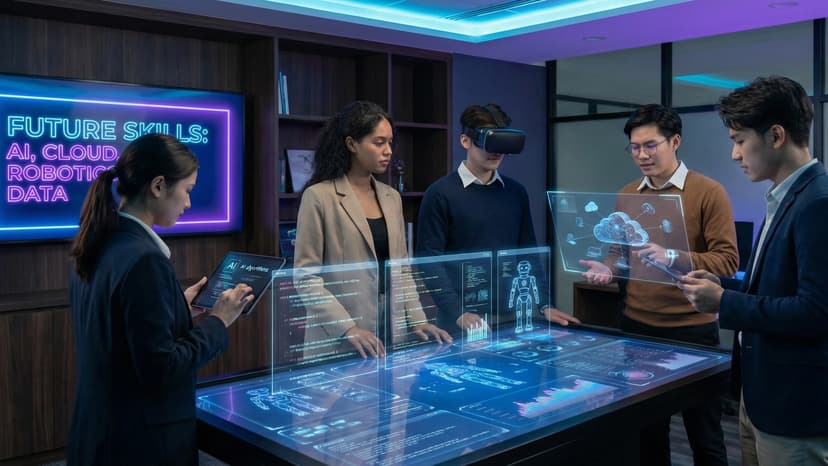
Technology is evolving at an unprecedented pace, and students who stay updated with the latest trends gain a significant advantage in academics, career readiness, and personal growth. Understanding emerging technologies helps learners adapt, innovate, and prepare for the future workforce.
1. Artificial Intelligence (AI) and Machine Learning (ML)
AI and ML are transforming industries by automating processes, providing insights from data, and enabling intelligent decision-making. Students should understand:
Basic AI concepts and algorithms
Applications in healthcare, finance, education, and robotics
Machine learning tools and platforms like TensorFlow and PyTorch
Knowledge of AI and ML equips students for careers in data science, software development, and research.
2. Cloud Computing
Cloud computing allows access to computing resources, storage, and applications over the internet. Students should be familiar with:
Platforms like AWS, Microsoft Azure, and Google Cloud
Cloud services such as SaaS, PaaS, and IaaS
Benefits like scalability, collaboration, and cost-efficiency
Cloud knowledge is critical for roles in IT infrastructure, DevOps, and enterprise solutions.
3. Cybersecurity
As digital dependence grows, protecting information and networks is more important than ever. Students should understand:
Network security basics
Encryption and authentication techniques
Common threats like malware, phishing, and ransomware
Cybersecurity skills are highly valuable across all industries.
4. Internet of Things (IoT)
IoT connects devices to the internet, enabling smart homes, wearable devices, and industrial automation. Students should know:
IoT device connectivity and protocols
Data collection and analysis from connected devices
Applications in healthcare, transportation, and smart cities
IoT knowledge prepares students for innovative engineering and tech-driven roles.
5. Mobile App Development
Mobile applications continue to drive innovation and engagement. Students should learn:
Android and iOS development fundamentals
Cross-platform app development tools
User experience (UX) and user interface (UI) design
Mobile app development skills open opportunities in software development, gaming, and digital entrepreneurship.
6. Data Analytics and Big Data
Data is the backbone of decision-making. Students should understand:
Data analysis tools like Excel, SQL, Python, and Tableau
Data visualization techniques
Interpreting trends for business and research
Data skills are in high demand for careers in analytics, research, and AI.
7. Augmented Reality (AR) and Virtual Reality (VR)
AR and VR are revolutionizing gaming, education, training, and entertainment. Students should explore:
AR/VR development tools and platforms
Applications in simulation, education, and marketing
Integration with mobile and web applications
AR/VR knowledge gives students an edge in creative technology and immersive experiences.
Read Article