Difference Between Frontend, Backend, and Full Stack Developer
December 15, 2025
6 min read
We wrote this so you can see how the topic works in practice. You can read it from anywhere. If you want lab practice next, we will help you pick a course in counselling.
Difference Between Frontend, Backend, and Full Stack Developer
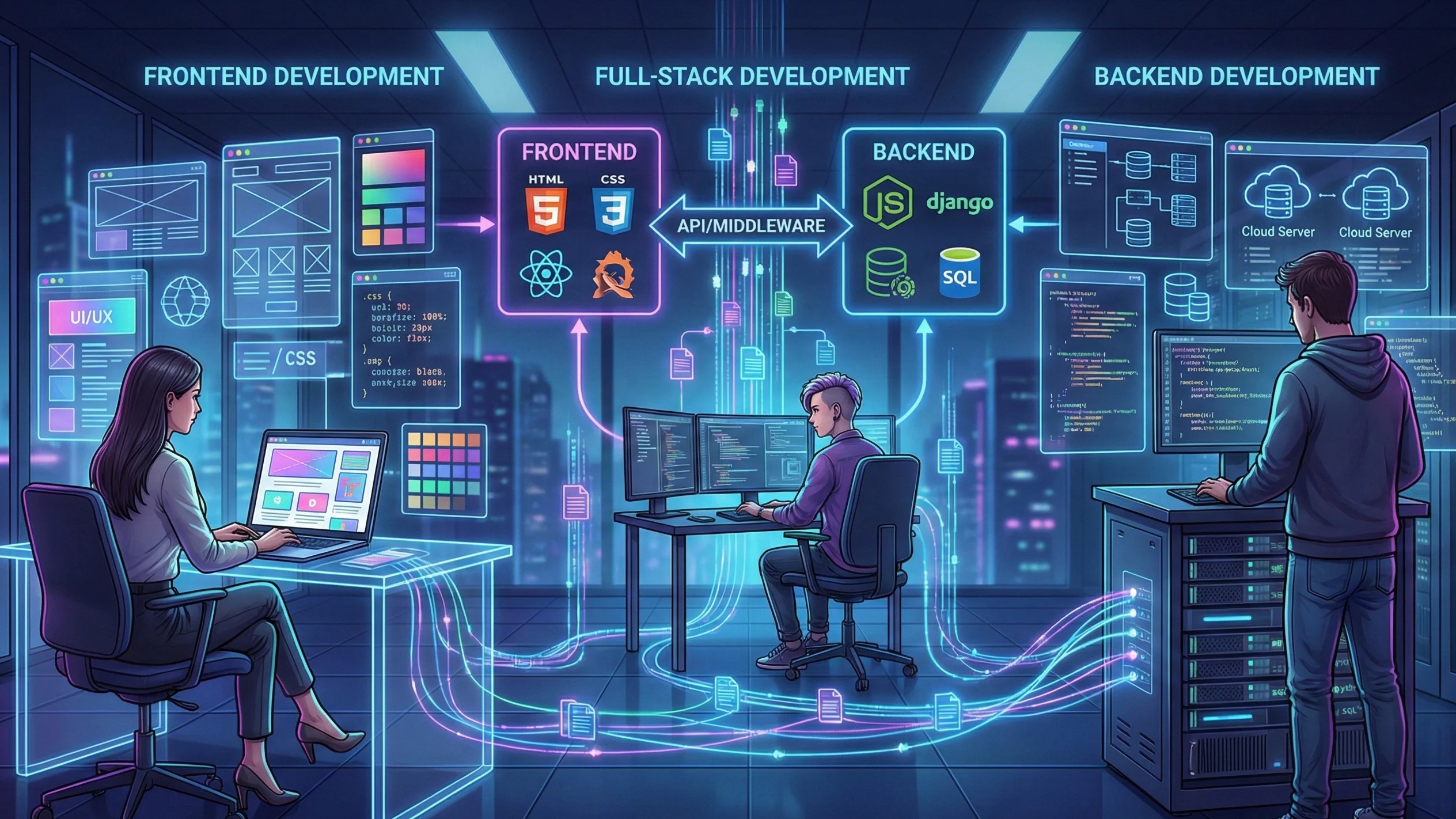
In web development, understanding the roles of frontend, backend, and full-stack developers is essential. Each plays a distinct role in building and maintaining websites and applications, and knowing the differences helps learners choose their career path.
1. Frontend Developer
A frontend developer is responsible for everything the user sees and interacts with on a website or application.
Key Responsibilities:
Designing the layout, structure, and visual elements of websites
Implementing responsive design for different devices
Ensuring a smooth user experience (UX)
Common Technologies:
HTML, CSS, JavaScript
Frameworks: React.js, Angular, Vue.js
Example: Designing a website’s navigation bar, buttons, and forms that users interact with.
2. Backend Developer
A backend developer works on the server-side of applications, managing data, databases, and business logic that users don’t see.
Key Responsibilities:
Creating and managing APIs for frontend communication
Handling databases and data storage
Implementing authentication, authorization, and server logic
Common Technologies:
Programming languages: Python, Node.js, Java, PHP
Databases: MySQL, MongoDB, PostgreSQL
Example: Managing user login systems, processing payments, or storing product information in a database.
3. Full Stack Developer
A full-stack developer is skilled in both frontend and backend development. They can build a complete application independently or collaborate effectively with specialized teams.
Key Responsibilities:
Designing and implementing frontend interfaces
Developing backend logic and database management
Ensuring integration between frontend and backend components
Common Technologies:
Frontend: HTML, CSS, JavaScript, React.js
Backend: Python (Django/Flask), Node.js, PHP
Databases: MySQL, MongoDB
Example: Building a complete e-commerce website with product listings, a shopping cart, payment processing, and user authentication.
Frontend Developer Role
Frontend Developer Role
A frontend developer is responsible for the user-facing side of a website or application. They focus on creating visually appealing, responsive, and interactive interfaces that provide a seamless user experience.
1. Key Responsibilities
Designing the User Interface (UI): Creating layouts, buttons, forms, menus, and other visual elements that users interact with.
Implementing Responsive Design: Ensuring websites and apps look and function well on desktops, tablets, and mobile devices.
Enhancing User Experience (UX): Optimizing performance, navigation, and accessibility to make applications intuitive and enjoyable to use.
Integrating APIs: Connecting frontend elements with backend services to display dynamic content, such as user profiles, product lists, or live data.
Testing and Debugging: Identifying and fixing UI issues across different browsers and devices.
2. Common Technologies
Frontend developers work with a combination of languages, libraries, and frameworks, including:
HTML: Structures the content of web pages
CSS: Styles the appearance of websites
JavaScript: Adds interactivity and dynamic behavior
Frameworks/Libraries: React.js, Angular, Vue.js
3. Skills Required
Strong understanding of UI/UX principles
Knowledge of responsive and mobile-first design
Ability to work with APIs and JSON
Familiarity with version control tools like Git
4. Real-World Examples
Designing a responsive e-commerce product page with interactive filters and image galleries
Creating a dashboard interface for a data analytics app
Building interactive forms for user registration and login
Backend Developer Role
Backend Developer Role
A backend developer is responsible for the server-side of applications, managing the logic, databases, and systems that power the frontend. While users interact with the frontend, backend developers ensure that everything works smoothly behind the scenes.
1. Key Responsibilities
Server-Side Logic: Writing code that handles application functionality, such as processing requests, performing calculations, and enforcing business rules.
Database Management: Designing, creating, and maintaining databases to store and retrieve data efficiently.
API Development: Building and integrating APIs that allow the frontend to communicate with the server and access data.
Security Implementation: Ensuring secure user authentication, authorization, and data protection.
Performance Optimization: Improving application performance and scalability by optimizing queries, server logic, and data handling.
2. Common Technologies
Backend developers work with various programming languages, frameworks, and databases, including:
Languages: Python, Node.js, Java, PHP, Ruby
Frameworks: Django, Flask, Express.js, Spring Boot
Databases: MySQL, PostgreSQL, MongoDB, Oracle
Tools: REST/SOAP APIs, version control (Git), cloud platforms
3. Skills Required
Strong logical and analytical thinking
Knowledge of server-side programming and database design
Understanding of security protocols and authentication
Familiarity with API integration and web services
4. Real-World Examples
Managing user authentication and login for a social media platform
Processing payments and transactions for an e-commerce website
Storing and retrieving patient data for a healthcare application
Building backend services for mobile apps like ride-hailing or food delivery
Who this is for
This is for students, job seekers, and working learners who want a clearer picture of the skill before they pick a course.
How we help you after you read
We help you see a career direction before you pick a course. You can start from where you are, including if you are new to IT. In lab we practise the role, not only names of tools. After a course, we stay with you until you get a job, based on your performance.
Share this article
What you can do next
If this topic is the skill you want to practise, we can map it to a course. Visit an Ahmedabad centre with your parents, or join through online admission if you live outside Ahmedabad.
Short answers about who this is for, what to do next, and how to talk to us.
Who should read Difference Between Frontend, Backend, and Full Stack Developer?
This is for students, job seekers, and working learners who want a clearer picture of the skill before they pick a course. You can read it from anywhere. If you want lab practice next, we will help you pick a course.
Do I need to visit Ahmedabad to use this article?
No, you can read it from anywhere. If you want to learn with us next, we warmly welcome you and your parents to visit one of our Ahmedabad centres — Maninagar, Nikol, or Vatva. If you live outside Ahmedabad, you can join through online admission with a counselling call.
Is this article the same as joining a CEC course?
No. We wrote this so you can understand the topic in plain language. A course is where you practise in lab, build work, and get feedback.
What should I do after I finish reading?
If this is the skill you want to practise, book counselling or open a related course. For this topic, you can start with Full Stack MERNN Developer with AI, Full Stack MERN Developer with AI, Full Stack Software Programmer, or browse all courses.
Can a parent use this to decide for a child?
Yes. You can read it together and then book counselling. School children of any grade start with counselling first — we do not enrol a child into a full career track without that conversation.
Can I start this skill after 10th or 12th if I did not pass?
After 10th or 12th, anyone can apply — pass, not pass, or a gap year, and any stream. Counselling is where we match the skill in this article to a course you can actually attend.
Will reading this get me a job?
No. An article is for understanding. If you join a course, complete practical work, and sit interviews, we stay with you until you get a job, based on your performance.
How do I talk to CEC about this topic?
Book counselling and mention this article, call +91 75740 10176, WhatsApp the same number, or email info@cecyours.org. In Ahmedabad, we would be glad to welcome you and your parents at a centre; outside Ahmedabad, we will set up a counselling call.