We wrote this so you can see how the topic works in practice. You can read it from anywhere. If you want lab practice next, we will help you pick a course in counselling.
Why Logical Thinking Matters in Programming
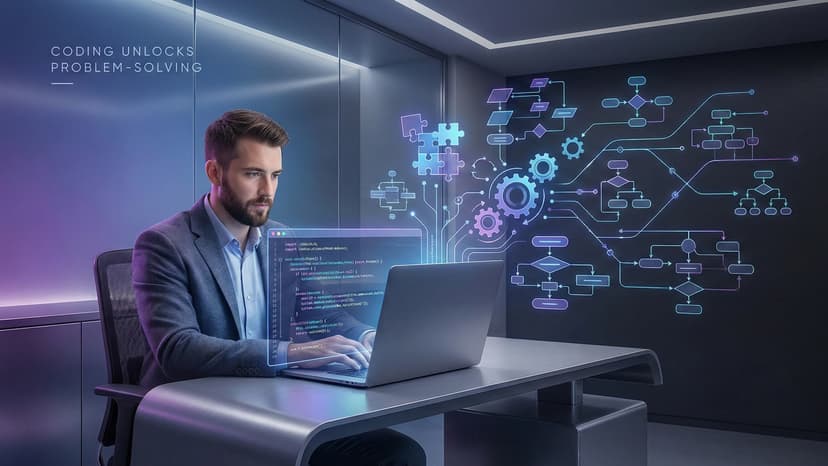
Logical thinking is the backbone of programming. It allows developers to break down problems, understand requirements, and create efficient solutions. Without logical thinking, writing effective, error-free code becomes extremely difficult.
1. Structuring Code Effectively
Programming requires organizing instructions in a sequence that the computer can execute correctly. Logical thinking helps developers:
Plan the sequence of operations
Decide on the right algorithms and data structures
Avoid redundant or inefficient code
Well-structured code is easier to maintain, debug, and scale.
2. Problem Decomposition
Complex problems in programming often cannot be solved all at once. Logical thinking allows programmers to divide problems into smaller, manageable tasks, making them easier to understand and solve.
Example: Creating a shopping cart system involves multiple smaller tasks: adding items, calculating totals, applying discounts, and processing payments. Logical thinking helps address each task systematically.
3. Debugging and Troubleshooting
Errors and bugs are inevitable in programming. Logical thinking enables developers to:
Identify the root cause of issues
Trace errors step by step
Implement solutions without introducing new problems
This skill saves time and reduces frustration during development.
4. Optimizing Solutions
Logical thinking allows programmers to evaluate multiple approaches and choose the most efficient solution. This improves:
Execution speed
Memory usage
Overall program performance
Optimization is critical for creating professional-grade software.
5. Enhancing Creativity in Coding
Though logical thinking is structured, it also enhances creativity. By understanding how systems work, programmers can innovate new solutions, combine technologies, and solve problems in unique ways.
6. Real-World Applications
Logical thinking in programming extends to real-world problem-solving:
Automating repetitive tasks
Designing data-driven systems
Developing algorithms for AI and machine learning
It ensures that programming skills translate into practical, impactful solutions.
Problem Breakdown
Problem Breakdown
In programming and technology, the ability to break down complex problems into smaller, manageable parts is a critical skill. Known as problem decomposition, this approach makes challenging tasks easier to understand, implement, and solve efficiently.
1. What is Problem Breakdown?
Problem breakdown involves analyzing a complex issue and dividing it into smaller sub-problems or steps. Each sub-problem can be tackled individually, then combined to form a complete solution. This method reduces confusion, prevents errors, and improves productivity.
Example: Building an e-commerce website involves multiple smaller problems:
User authentication and login
Product catalog management
Shopping cart functionality
Payment processing
Order tracking and notifications
By addressing each part separately, developers can create a robust, scalable system without being overwhelmed.
2. Benefits of Problem Breakdown
Simplifies Complexity: Large problems feel less intimidating when divided into smaller parts.
Improves Focus: Developers can focus on solving one task at a time.
Enhances Accuracy: Smaller tasks are easier to test and debug.
Facilitates Collaboration: Team members can work on different sub-problems simultaneously.
3. Problem Breakdown in Programming
In coding, problem breakdown is applied through techniques such as:
Modular Programming: Writing functions or modules for specific tasks
Algorithm Design: Breaking problems into logical steps and conditions
Flowcharts and Pseudocode: Planning solutions before writing actual code
These practices ensure that programs are organized, maintainable, and scalable.
4. Real-World Applications
Problem breakdown is not limited to programming. It is valuable in:
Project management and planning
Data analysis and research
Daily problem-solving and decision-making
Learning this skill in programming strengthens overall analytical and critical thinking abilities.
Programming Efficiency
Programming Efficiency
Programming efficiency refers to the ability to write clean, optimized, and effective code that solves problems quickly while using minimal resources. Efficient programming is crucial for building high-performance software, saving time, and reducing maintenance challenges.
1. What is Programming Efficiency?
Programming efficiency involves:
Writing code that performs tasks with minimal processing time
Reducing memory and resource consumption
Avoiding unnecessary repetition and complexity
Ensuring the code is readable, maintainable, and scalable
Efficient programming is not just about speed; it also focuses on creating robust, error-free software.
2. Techniques to Improve Efficiency
Use of Algorithms and Data Structures: Choosing the right algorithm and data structure can significantly improve performance.
Code Reusability: Writing functions, modules, or classes that can be reused in multiple parts of the program.
Avoiding Redundant Code: Eliminating duplicate or unnecessary operations.
Optimized Loops and Conditions: Designing loops and conditional statements for minimal iterations.
Proper Debugging and Testing: Identifying and fixing bottlenecks early.
3. Benefits of Efficient Programming
Faster Execution: Programs run quicker and respond better to user inputs.
Reduced Resource Usage: Lower CPU, memory, and storage consumption.
Easier Maintenance: Clean and organized code is simpler to update and debug.
Better Scalability: Efficient programs can handle larger datasets or more users without breaking down.
4. Real-World Examples
Optimizing search algorithms for e-commerce websites to quickly display products
Writing efficient data processing scripts to analyze large datasets
Designing lightweight mobile apps that run smoothly on various devices
These examples show how programming efficiency directly impacts user experience and system performance.
Who this is for
This is for students, job seekers, and working learners who want a clearer picture of the skill before they pick a course.
How we help you after you read
We help you see a career direction before you pick a course. You can start from where you are, including if you are new to IT. In lab we practise the role, not only names of tools. After a course, we stay with you until you get a job, based on your performance.
Share this article
What you can do next
If this topic is the skill you want to practise, we can map it to a course. Visit an Ahmedabad centre with your parents, or join through online admission if you live outside Ahmedabad.
Short answers about who this is for, what to do next, and how to talk to us.
Who should read Why Logical Thinking Matters in Programming?
This is for students, job seekers, and working learners who want a clearer picture of the skill before they pick a course. You can read it from anywhere. If you want lab practice next, we will help you pick a course.
Do I need to visit Ahmedabad to use this article?
No, you can read it from anywhere. If you want to learn with us next, we warmly welcome you and your parents to visit one of our Ahmedabad centres — Maninagar, Nikol, or Vatva. If you live outside Ahmedabad, you can join through online admission with a counselling call.
Is this article the same as joining a CEC course?
No. We wrote this so you can understand the topic in plain language. A course is where you practise in lab, build work, and get feedback.
What should I do after I finish reading?
If this is the skill you want to practise, book counselling or open a related course. For this topic, you can start with C++ Programming, Data Science & AI Expert with Python, Advanced C Programming, or browse all courses.
Can a parent use this to decide for a child?
Yes. You can read it together and then book counselling. School children of any grade start with counselling first — we do not enrol a child into a full career track without that conversation.
Can I start this skill after 10th or 12th if I did not pass?
After 10th or 12th, anyone can apply — pass, not pass, or a gap year, and any stream. Counselling is where we match the skill in this article to a course you can actually attend.
Will reading this get me a job?
No. An article is for understanding. If you join a course, complete practical work, and sit interviews, we stay with you until you get a job, based on your performance.
How do I talk to CEC about this topic?
Book counselling and mention this article, call +91 75740 10176, WhatsApp the same number, or email info@cecyours.org. In Ahmedabad, we would be glad to welcome you and your parents at a centre; outside Ahmedabad, we will set up a counselling call.