Ethical Hacking Course in Nikol, Ahmedabad

Ethical hacking here means a check you can finish: one host on a lab network, one thing that should not be open, and the change you make so it stops. You will see what sniffing, a weak lab secret, and hardening each ask you to do. At Computer Education And Cybernetics (CEC) we practise that with you, and a mentor reads the note. The lab is near New DMart at Satyam Plaza.

Or reach us directly

+91 91049 37871 · info@cecyours.org

One host, from what you find to what you change

  1. The inventoryServices that should answer
  2. One captureTraffic on the lab range only
  3. One lab hashA secret we give you to test
  4. The recheckThe extra service stays closed
You practise on
A lab network we own
Sniffing is
Watching allowed traffic
You leave with
A hardening note
You start with
Counseling

How does a network check become a hardening change?

You compare one practice host to a written list of services, watch one allowed login, and test one lab secret. Then you change the host and prove the extra service stopped. A printout of open doors is not the end of the work.

Ethical hacking on a network means testing a lab range you are allowed to touch, comparing one host to the services it should run, and hardening what you confirm: close the extra service, replace a weak lab secret, and recheck. Network sniffing is watching that allowed traffic. A vulnerability assessment is the comparison. Computer Education And Cybernetics (CEC) teaches this on hosts we control and does not assign tests on networks you do not own.

  • A port is a door the host keeps open

    A port is a numbered door a computer leaves open for one kind of traffic. Ethical hacking on a network starts when you can say which doors the practice host should keep open, and which answer you did not expect.

  • Sniffing is one allowed conversation

    Network sniffing means watching traffic on a network you are allowed to see. On our lab range you capture one login the practice server makes, and you look for a password or a service name travelling in readable text.

  • A lab hash is a scrambled secret

    A hash is a scrambled copy of a password. Password cracking, in this lab, means we hand you that copy from a machine you may test and you check it against a short practice list we provide. A match shows the secret was weak, so you replace it on that host. It is not a licence to try that word anywhere else.

  • Hardening is the change you can recheck

    You stop the extra service on that lab host, replace the weak lab password, and look again. The note is finished when the extra door no longer answers. Finding the door without closing it is only half the lab.

A task on paper first

Write three services you expect a lab file server to answer. In the lab, mark any answer that is not on your list. That mark is what you will close, after a mentor agrees the list was right. Across our centres we have conducted 20,000+ of training; this hour is spent on that one host, not a tour of tool names.

A worked example: one host that should have stayed quiet

The check is allowed because the server is ours. The skill is changing the host and writing only what you rechecked.

  1. Input

    The written inventory says the practice server should answer only on its web service. Anything else is a candidate, not yet a finding.

  2. What you look at

    A second service answers. A capture of one lab login on that service shows the password in readable text. The lab hash we handed you also matches a word on the short practice list.

  3. Decision

    Both belong to this host, and the inventory did not allow the second service. You stop. You do not try the matched word on any other account, Wi-Fi, or website.

  4. What you write

    The extra service, that the login was readable, that the lab secret matched the practice list, that you stopped the service, replaced the secret, and rechecked that the service no longer answers.

The miss that belongs in the note

The first extra answer was a management page the inventory had left off. You do not close it until a mentor agrees the list is the rule. That miss is part of the lab: you learned to check the inventory before you call something a weakness.

An honest limit: this lab makes you accurate on one practice host and a small lab network. Testing live companies, wireless networks you do not own, or a full hunting workload comes later, and only with permission. Web-app checks are a different bench — see the Maninagar ethical hacking lab.

Where are network checks and hardening heading?

Two changes are already in this work. You still recheck the host yourself, including when an assistant wrote the first draft of the hardening lines. We ask you to show the before and the after: the service answered, then it did not.

  • Assistants draft a hardening list from a port printout

    The same practice host now comes back with a ready-made list of services to close, including doors you never confirmed and doors the inventory says must stay open. The draft grew. Your recheck did not.

  • Assessment tools mark every open door as urgent

    A host that correctly answers on its web service gets the same warning as a service nobody allowed. The stable skill is still the comparison: inventory, one host, then proof the extra door stopped.

Where an assistant still fails you

  • It tells you to watch a network, a shop Wi-Fi, or a company you were not given
  • It says a password was recovered when your practice list did not match
  • It tells you to close a service the inventory says must stay open

Network testing is shifting as assistants draft hardening lists and assessment tools mark every open service as urgent. The durable skill is comparing one host to its inventory and proving the extra service stopped. CEC trains that recheck in the lab. A generated list does not replace it.

How we teach you to harden one lab host

About 80% of our training is practical. Our 25+ full-time corporate trainers read the note the way a reviewer would: Did you stay on the lab range, and did the service actually stop answering?

  1. 1. Counseling picks the first bench

    School learners of any grade start with counseling. After 12th anyone can apply, from any stream, including college students and career changers. If you cannot yet say what a service is, we start with how a host answers, then this lab.

  2. 2. One host until the note survives a reread

    You stay on a practice server we control. A mentor sends the note back when you left the lab range, when the impact is vague, or when you closed a service and did not check that it stopped.

  3. 3. Three short checks, each ending in a change

    One capture, one lab hash, one inventory comparison. Each ends with a hardening line: what you closed or replaced, and what you saw when you looked again.

  4. 4. An assistant may draft the lines

    You can ask it to phrase the note. You then delete any sentence you cannot point to in the capture, the practice-list match, or the recheck.

Computer Education And Cybernetics (CEC) teaches this network check inside the Cyber Security and Ethical Hacking with AI course. You start with counseling, practise one capture, one lab hash, and one inventory comparison, and leave with a hardening note a mentor can recheck. We stay with you until you get a job, based on your performance.

This lab is part of our Cyber Security & Ethical Hacking with AI course, not a separate product. The Ahmedabad ethical hacking page describes the wider path. Firewalls and segments sit on the network security course.

Placement support and certificates

The hardening note is the proof you can show. We help you put it in a portfolio, then we stay with you for the job search.

How we stay with you

  • We stay with you until you get a job, based on your performance in training, projects, and interviews
  • Our 5-step placement preparation covers your resume, the hardening note, communication, and mock interviews
  • The before-and-after note — what answered, what you changed, what stopped — is what you can show
  • Course completion certificates are issued after you finish the practical requirements

More detail on placement support at CEC.

What sniffing, a lab hash, and an assessment each ask of you

These are three jobs inside the same host lab, not three courses. After 12th anyone can start, from any stream. College students use the note as lab work beyond the syllabus. Career changers use it to show a change they made, not a list of tool names. School learners of any grade begin with counseling.

  • Sniffing

    You watch one conversation on the lab range and write whether a secret travelled in readable text. You do not point the capture at the plaza, a neighbour, or a network you do not own.

  • A lab hash

    You test one scrambled lab secret against the short list we give you. A match means you replace that secret on the lab host. No match means you write “not shown” and stop.

  • An assessment

    You compare the inventory to what the practice host answers. One unexpected service is the candidate. You confirm it is our host before you call it a weakness.

How you reach the Nikol lab

CEC Nikol is Near / opposite New DMart, Nikol (Satyam Plaza). The centre sits at Satyam Plaza on Raspan Cross Road. Easy from Naroda, Vastral, Nikol. Visiting is optional — counseling by phone comes first.

Satyam Plaza

S -25/26, D-mart, Satyam Plaza, Raspan Cross Rd, opp. Suketu Residency, near Nikol, Ankur Chokadi, New India Colony, Nikol, Ahmedabad, Gujarat 382350. Call +91 91049 37871 before you travel so we can confirm the day.

  • Mon – Sun: 9:00 AM – 8:00 PM
  • CEC Nikol building at Satyam Plaza near New DMart
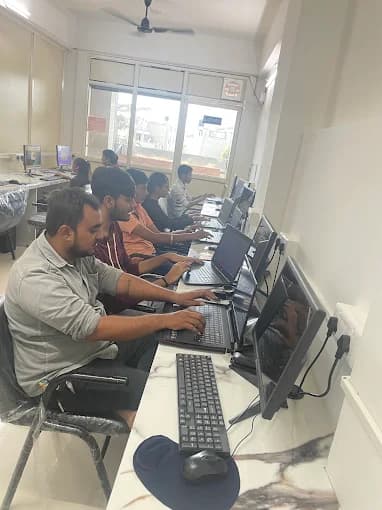
  • CEC Nikol computer lab

Who reviews the hardening note here

  • Nishant Yadav

    Hardware Networking · 3+ years

    Teaches Cyber Security and Server Administration. In this lab, the review is whether you stayed on our range and whether the extra service actually stopped.

Our three centres in Ahmedabad

This lab is at Nikol. Maninagar and Vatva are available when counseling places you there. Visiting any centre is optional.

Questions before a network lab

If you are unsure whether to start with the practice host or with how a machine answers, bring that to counseling.

  • How does an ethical hacking check on a network actually work?

    You test only a lab network you were given. You compare a written inventory of services to what one practice host answers, you watch one allowed login, and you check one lab hash against a short practice list. Then you harden that host: close what should be closed, replace a weak lab secret, and recheck. At Computer Education And Cybernetics (CEC) that work stays on systems we control.

  • What is the difference between sniffing, a lab hash, and hardening?

    Sniffing is watching traffic you are allowed to see, to learn whether a secret travels in readable text. Password cracking here is a lab hash check: whether a scrambled lab password matches a short list we give you. Hardening is the change afterwards: the extra service stops, the weak secret is replaced, and you write the before and after. A capture or a match without that change is not finished work.

  • Will I be testing real company networks or public Wi-Fi?

    No. Labs use a network range and hosts CEC controls. Watching a shop network, a neighbour, or a site you were not given is not part of the course. Permission is the first rule, including when an assistant suggests a target.

  • What do the first labs cover?

    Reading an inventory of services, capturing one lab login, checking one lab hash against a practice list, and closing one unexpected service on the practice host. You leave with a short note a mentor can recheck.

  • Do I need networking before I start?

    You need enough to say what a host and a service are. If that is new, counseling starts you on hardware networking and how a machine answers, then this lab. College students and career changers who already use networks at work can start with the inventory.

  • Where is this kind of testing heading?

    Assistants already draft hardening lists from a port printout, and assessment tools already mark every open service as urgent. The work that stays valuable is comparing one host to its inventory and proving the extra service stopped. A draft that invents a closed door does not replace that recheck.

  • How does CEC help me practise this?

    You work on one practice host, run the capture, the lab-hash check, and the inventory comparison, and rewrite the note until a mentor can recheck it. About 80% of training time is practical. Counseling decides whether you start with the host itself or with how a machine answers. The practice sits inside our Cyber Security and Ethical Hacking with AI course.

  • Can I start after 12th, from college, or as a career changer?

    Yes. After 12th anyone can apply, from any stream. College students who want lab time beyond the syllabus, and career changers moving into security work, start with the same counseling. School learners of any grade start with counseling before a course. You do not need a prior hacking background.

  • How do I reach the Nikol lab?

    CEC Nikol is Near / opposite New DMart, Nikol (Satyam Plaza), at Satyam Plaza on Raspan Cross Road. Easy from Naroda, Vastral, Nikol. Learners also come from Nikol, Naroda, Vastral. The centre is at S -25/26, D-mart, Satyam Plaza, Raspan Cross Rd, opp. Suketu Residency, near Nikol, Ankur Chokadi, New India Colony, Nikol, Ahmedabad, Gujarat 382350. Call +91 91049 37871 before you visit.

  • Can I start without visiting Nikol?

    Yes. Counseling is by call, WhatsApp, or email on +91 91049 37871 or info@cecyours.org. Visiting the lab is optional. If another Ahmedabad centre is easier, say so in counseling and we will place you where the same practice fits.

Harden one lab host, then write the change

Tell us what you already know about networks. We will start you on the practice host or on foundations — and the lab stays on systems we own.

Or reach us directly

+91 91049 37871 · info@cecyours.org