LLM App Development Course in Nikol, Ahmedabad
A chat demo answers once; usable software has to answer on a slow day too. You will understand the whole request path behind an LLM feature — what you send, what you check, and what the user sees when the call fails — and we practise each stage with you until it holds. At Computer Education And Cybernetics (CEC) mentors review your request log before a project counts as done.
Or reach us directly
+91 91049 37871 · info@cecyours.org
One tap, five stages you own
- CheckAccept the question, reject empty or oversized input, and record who is asking.
- BudgetDecide what fills the context this time — instruction, recent turns, the needed records.
- CallOne service function, key on the server, a timeout and one retry.
- ValidateRead the reply as named fields and reject it when a required field is missing.
- ShowRender the answer, or the planned fallback, and log duration and status.
- You build in
- Python
- You design
- The request path
- Hands-on
- ~80%
- First step
- Counseling
What happens between the tap and the answer?
Six stages, all of them ordinary code. The model sits in the middle; the other five decide whether people can trust the feature.
LLM app development is building software around a large language model: the application checks the incoming request, budgets what text enters the model's context window, calls the model API once with a timeout, validates the structured reply field by field, and renders either the answer or a planned fallback. The model generates text; the application decides what it may see, what it may do and what the user is shown. After this practice you can ship a single LLM feature with logs, limits and a failure path, while longer multi-step workflows need more time. Computer Education And Cybernetics (CEC) teaches this path in lab projects reviewed by mentors.
The input check
A large language model (LLM) predicts text from whatever you send it, so your code decides what is allowed to arrive: length limits, empty questions blocked, and the user identity attached so the answer only uses records that person may see.
The context budget
A context window is the most text a model can read in one call, counted in tokens — roughly word pieces. You spend that budget on purpose: system instruction, the last few turns, and the exact records needed, instead of appending the whole conversation forever.
The API call itself
One function owns the vendor API — the web interface you send the request to. The key lives in a server environment variable, the call has a timeout, one retry, and a recorded duration so a slow provider cannot freeze your screen.
The output contract
Ask for structured output: JSON with named fields such as answer, used_rows and needs_human. Your code validates those fields before anything renders, so a half-written reply never reaches the user.
Tool calling
When the question needs a live fact or an action, the model may only name a tool from a list your code allows. Your code checks the arguments, runs the tool, and sends the result back as data — the model never touches your database directly.
The safeguards
A fallback screen when the call fails, a refusal path when the records do not answer the question, a per-user rate limit, keys never in client code, and one log line per request with duration, tokens and status.
Practice task
Take one question your app must answer and write the five stages on a single sheet: what you accept, what you send, what the reply must contain, what happens at twenty seconds, and the exact sentence the user reads when the call fails. What we do with you here: a mentor marks the sheet before you write the first live call, because a missing fallback line is cheaper to fix on paper.
A worked example: the answer arrives, the screen still spins
Input, what you look at, the decision, what you write down. This is the debugging habit we practise with you, because the second week of a project is where features break.
The feature
A practice college-portal app answers timetable questions. Your endpoint takes the question, passes the student's timetable rows, and expects JSON with answer, used_rows and needs_human.
First failure
The first demo works. In a ten-minute conversation the sixth question takes forty seconds and the screen keeps spinning. A classmate's build renders the raw reply and the page breaks when the model returns a sentence instead of fields.
What you look at
Your own log line: duration, input tokens, status. The provider error says the request exceeded the context length, and a second attempt is refused for too many requests. The validator shows the answer field missing on the broken build.
The decision
Cap history at the last four turns plus today's timetable rows. Set a twenty-second timeout with one retry. Validate fields before render. Disable the ask button while a request is open. Write the fallback line the user sees when the call fails.
After the fix
The sixth question stays inside the budget, a failed call shows the timetable table with a plain message instead of a spinner, and malformed replies are rejected before render rather than crashing the page.
What you write down
A request log table with duration, tokens and status before and after, the context budget rule, the output fields, and the exact fallback copy. That sheet is the proof mentors review with you.
When the answer must come from documents rather than database rows, the passage work is covered in GenAI developer in Nikol. When one call grows into a planned sequence, see AI agents in Nikol.
When should your app call a tool or fetch a record first?
Decide in code, before the call. A model that is allowed to request anything will eventually request something you cannot explain to a user.
If your own records hold the answer, fetch first
Query the rows in code, pass only those into the call, and ask the model to answer from them. Nothing is remembered between calls, so anything you did not send does not exist for that request.
If the action changes data, the model only proposes
Cancelling a booking or sending a message runs in your code after a permission check and a user confirmation. The model returns an intent; your code decides whether it is allowed.
Keep the tool list small and typed
Each tool has a name, declared arguments and a validator. Anything outside that list is rejected instead of guessed, which keeps failures readable when a release goes wrong.
What we do with you here: you write the tool list and its argument checks first, then a mentor tries to make your app run a tool it was never meant to run.
How do you know the feature is ready for real users?
You run an evaluation set — a fixed list of real questions with expected outcomes — and you count passes. A demo that worked once is not evidence.
What we check before a project counts as done
- Fifteen to twenty real questions with expected outcomes, including three that must refuse and three that must call a tool
- A pass count recorded before every release, not a single impressive screenshot
- Timeout, retry and fallback exercised on purpose by pointing the app at a dead endpoint
- Keys read from server environment variables, with a per-user rate limit in front of the endpoint
- Duration and token count logged per request so cost and speed are visible before users complain
An LLM feature is release-ready when a fixed evaluation set of real questions passes, including the questions the application must refuse, and when the safeguards have been tested on purpose: timeout with a fallback screen, per-user rate limits, API keys read from server environment variables, and duration and token counts written to a log. Computer Education And Cybernetics (CEC) uses that same list in lab reviews, so a learner leaves with pass counts rather than one lucky screenshot.
Here the evaluation set confirms a request path you already guarded. If you would rather start from the cases themselves — writing the questions an app must not answer before any wiring — that is the lead of LLM app development in Maninagar.
Where is LLM app development heading?
Provider features keep absorbing the glue code, while the judgement about limits and failure paths stays with you. What we do with you here: in lab we change the output shape your app expects, so you find out which parts of your code survive a provider change and which parts you had hard-coded.
Context windows grew, and pasting everything still breaks apps
Models now read far more text in one call, so teams stopped trimming. Latency and token cost climb and answers get vaguer. Budgeting context has moved from a hard limit workaround to a cost and quality decision you defend.
Structured output and tool calling moved into the API
Providers now accept a schema and return named fields, so hand-written parsers that scraped free text are fading. Validating the fields before you render has not changed — that check is what protects the screen.
Where AI coding helpers still fail on this work
- It writes a working model call with no timeout, retry or fallback branch
- It appends the whole conversation every time and never mentions the token budget
- It renders the reply straight to the screen without checking that required fields exist
LLM application work is shifting as context windows grow and as structured output and tool calling move into the provider APIs, which removes much of the parsing code developers once wrote by hand. The skill that stays valuable is operational judgement: budgeting what enters the context, reading request logs for duration and tokens, and writing the failure path a user meets when the model is slow or wrong. Computer Education And Cybernetics (CEC) trains learners to keep those habits whichever provider a team adopts next.
How we teach LLM app development
Counseling first, then four rounds of build and break with mentor review on your log sheet — not a single demo at the end.
1. Counseling checks where you start
Whether you are ready for application work or should practise prompts and Python basics first. School learners of any grade start with counseling first, and after 10th or 12th anyone can apply.
2. You draw the request path before you write the call
Stages on paper, output fields named, fallback copy written. Mentors send it back when there is no failure path — a feature with only a happy path is not finished here.
3. You break it on purpose in the lab
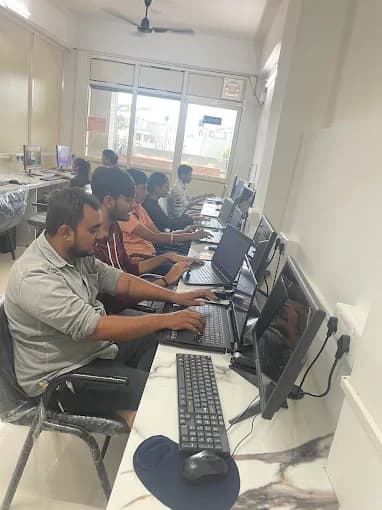
About 80% of training time is practical, and across our three centres we have run 20,000+ hours of training. You point the app at a dead endpoint, send oversized input and return invalid fields until each one has a planned answer.
4. You leave with a release packet
Request log table, output fields, the evaluation sheet with pass counts, fallback screens and the repository — evidence you can walk an interviewer through line by line.
Batches here stay small enough that your request path is read line by line. Instruction and context work is reviewed with the mentor who teaches prompt engineering at this centre, and key handling, rate limits and server settings sit with the server administration side of the roster — both are named further down this page.
At Computer Education And Cybernetics (CEC), LLM application training starts with a counseling session that checks your programming base, then moves into lab work: you draw the request path, build the model call, break it with timeouts, oversized input and invalid replies, and fix each failure while a mentor reviews your log sheet. You leave with a release packet — log table, output fields, evaluation pass counts and fallback screens. We stay with you until you get a job, based on your performance in training, projects and interviews.
AI Development using Python (Job Oriented)
The catalogue course this application practice sits inside, with the Python and project work around it.
View courseGenerative AI & LLM Development
When counseling places model behaviour and generation beside the application wiring.
View coursePlacement support and certificates
A release packet answers the interview question most candidates miss: what did you do when the model was slow, wrong or down?
How we stay with you
- We stay with you until you get a job, based on your performance in training, projects and interviews
- Our 5-step placement preparation covers your resume, portfolio, communication and mock interviews
- Mock interviews use your own request log and evaluation sheet, so your answers stay specific
- Course completion certificates are issued after you finish the practical requirements
Who is this LLM application path for?
College learners, career changers and working professionals who want an AI feature other people can use — not only a demo that works once.
College students
Ship one LLM feature with a logged request path and a fallback screen — stronger in a viva than a chat demo.
Career changers
If basic programming is in place, counseling maps this application work inside AI Development using Python.
Working professionals
Put an internal assistant in front of colleagues with rate limits, logs and a refusal path you can defend.
Coming from a non-technical degree or a different industry? That is a common start here, and counseling maps the foundation subjects before application work instead of pushing you straight into code. The citywide LLM app development page covers the same path for learners choosing between our centres.
Visiting CEC Nikol for LLM application counseling
Near / opposite New DMart, Nikol (Satyam Plaza). Easy from Naroda, Vastral, Nikol. Learners also come from Nikol, Naroda, Vastral. Hours: Mon – Sun: 9:00 AM – 8:00 PM.

Nishant Yadav
Hardware Networking · 3+ years
Cyber Security · Server Administration
Shivani Sharma
Software Faculty · 4+ years
CCC · Tally Prime · Prompt Engineering · Graphic Design
Full address and map: CEC Nikol location details. To see where AI learning starts at this centre, read the AI course in Nikol.
Our three centres in Ahmedabad
For classroom admission we warmly welcome you and your parents to visit — Nikol is shown first because this page is for learners choosing that centre. Please choose whichever centre is easier for you. Learning from outside Ahmedabad? We complete admission online after a counseling call.
CEC NikolThis page
Near / opposite New DMart, Nikol (Satyam Plaza)
S -25/26, D-mart, Satyam Plaza, Raspan Cross Rd, opp. Suketu Residency, near Nikol, Ankur Chokadi, New India Colony, Nikol, Ahmedabad, Gujarat 382350+91 91049 37871CEC Maninagar
~2 minutes from Maninagar Railway Station
2nd floor, Gopal Tower, Computer Education And Cybernetics, near Maninagar Railway Station Road, Maninagar, Ahmedabad, Gujarat 380008+91 75740 10176CEC Vatva
Near Vatva Lake Garden; opposite Kashiben Hospital
1st Floor, Computer Education And Cybernetics, Opposite Kashiben Hospital Beside Khodiayar Vav, Near Vatva Lake Garden, Vinzol Crossing Rd, Deriya Para, Vatva, Ahmedabad, Gujarat 382440+91 91571 90839
Related guides
- LLM app development in AhmedabadCitywide view of the same application path
- GenAI developer in NikolRetrieval fixtures and cited passages
- AI agents in NikolWhen one call becomes a multi-step loop
- Prompt engineering in NikolInstruction layers before heavy coding
- LLM app development in ManinagarSame course, led by evaluation cases
- AI course in NikolWhere AI learning starts at this centre
- Book a counseling sessionCheck your base before application work
Questions about LLM app development
What is LLM app development?
LLM app development is building normal software around a large language model: your code receives the request, decides what text goes into the call, sends it to the model API, checks the reply and renders it. The model is one step inside that path, not the product. What makes it usable software is everything around that step — limits, validation, logging and a working failure path.
How does an LLM app actually answer one question?
Your code checks the input, builds the context from the instruction plus the records needed, calls the model once with a timeout, reads the reply as named fields, and renders either the answer or your fallback. Each stage is ordinary code you can test on its own, which is why a broken feature can be traced to one stage instead of blamed on the model.
Do I need strong programming before I start?
You need comfort with functions, files and error handling in Python. Counseling places foundations or prompt practice first when that base is missing. After 10th or 12th anyone can apply, and school learners of any grade start with counseling first.
How is this different from the GenAI developer path?
The GenAI developer page centres on retrieval — splitting documents, selecting passages and proving answers cite a source. This page centres on the application around the call: context budget, timeouts, validated fields, tool permissions and release tests. Many learners take them in sequence after counseling.
How is this different from the AI agents path?
An agent plans several steps and re-plans after each result, so that page is about state and the loop. Here you build the single request path first — one call, one contract, one fallback — which is what most product features actually need.
Is this the same course we run at CEC Maninagar?
It is the same learning path inside AI Development using Python, taught at a different centre with a different starting point. The Maninagar page leads with evaluation cases — writing the questions an app must not answer first. This centre leads with the request path around the call: input checks, context budget, timeouts, validated fields and the fallback a user sees. Please choose whichever centre is easier for you.
What makes an LLM feature ready to show real users?
A small evaluation set of real questions with expected outcomes, including questions the app must refuse, plus safeguards you tested on purpose: timeout and fallback, per-user rate limits, keys on the server, and logged duration and tokens. We run that set before a learner calls a project finished.
Where is LLM app development heading?
Two changes are already visible: context windows grew, so budgeting text became a cost and quality decision rather than a limit workaround; and structured output with tool calling moved into the provider APIs, so hand-written parsers are fading. Reading your own request logs and writing the failure path stay valuable whichever provider you use next.
How does CEC help you learn LLM app development?
We start with counseling, then lab practice where about 80% of training time is hands-on: you draw the request path, build the call, break it with timeouts and invalid replies, and fix it while mentors review your log sheet. You leave with a release packet, and our 5-step placement preparation covers resume, portfolio, communication and mock interviews. We stay with you until you get a job, based on your performance in training, projects and interviews.
How do I reach the Nikol centre?
CEC Nikol is Near / opposite New DMart, Nikol (Satyam Plaza). Easy from Naroda, Vastral, Nikol. Learners also come from Nikol, Naroda, Vastral. Hours are Mon – Sun: 9:00 AM – 8:00 PM, and a call to +91 91049 37871 before you come saves a wait.
Do I need to visit before classroom admission?
For classroom admission we warmly welcome you and your parents to visit — meet the mentors and staff, see the lab and how classes run, and ask your questions face to face. Call or WhatsApp +91 91049 37871 to book a time, and please choose whichever centre is easier for you. Learning from outside Ahmedabad? We are happy to guide you on a counseling call and complete your admission online.
Bring one feature idea — we will write its failure path first
In counseling at CEC Nikol we check your programming base, sketch the request path for your idea, and tell you honestly whether prompt practice should come before application work.