Cyber Security Course in Nikol, Ahmedabad
Cyber security is one connected path, not a list of tools: foundations, networking, ethical hacking, defence, SOC work and AI-assisted security, each building on the last. You will understand how the stages fit together, and we help you practise every one on our own lab servers.
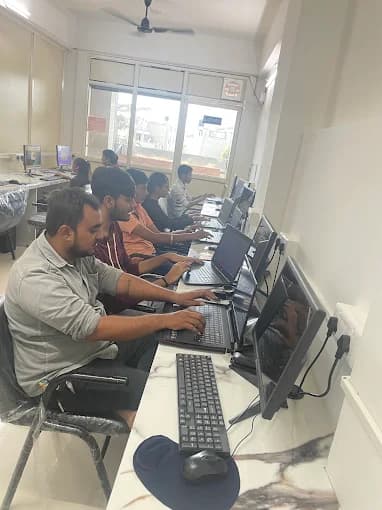
At Computer Education And Cybernetics (CEC) this runs at our centre at Satyam Plaza (Near / opposite New DMart, Nikol (Satyam Plaza)). Counseling comes first, at the centre — we warmly welcome you and your parents to visit before admission.
Or reach us directly
+91 91049 37871 · info@cecyours.org
The path, stage by stage
1
Foundations
Operating systems, accounts, files
2
Networking
Addresses, services, how traffic moves
3
Ethical hacking
Authorised testing, then a report
4
Defence
Hardening and recheck on lab servers
5
SOC work
Alerts, triage, escalation
6
AI-assisted security
Drafts you verify against evidence
Where you usually start
- After 12th
- Start at foundations
- College IT
- Often start at networking
- Career changer
- Foundations, at your pace
- Working in IT
- Gap check, then skip ahead
How do the stages of cyber security fit together?
Each stage gives you one way of reading the same machines. Foundations show you accounts and logs, networking shows how machines reach each other, testing shows how weaknesses are found, defence shows how they are closed, and SOC work shows how you notice when something changes.
Cyber security is the practice of protecting computers, networks and accounts by understanding how they work, testing them with permission, closing weaknesses and watching for unexpected change. A learning path usually moves through security foundations, networking, ethical hacking, defensive practice, security operations centre (SOC) concepts and AI-assisted analysis. At Computer Education And Cybernetics (CEC) in Ahmedabad, learners practise each stage on CEC’s own isolated lab servers.
1. Security foundations
What it is: How an operating system stores accounts, permissions and logs, on Windows and Linux.
What you practise: You list the accounts on a lab server and say which ones can change system settings.
2. Networking
What it is: Addresses, ports, services and how one machine reaches another through switches and routers.
What you practise: You draw the lab network and mark which services each machine should and should not offer.
3. Ethical hacking
What it is: Authorised testing in stages: scope, mapping, assessment, confirming what can be shown, reporting.
What you practise: You work from a signed scope sheet on our own lab servers and write each finding with a fix.
4. Defensive practice
What it is: Closing what should not be open, tightening accounts and checking that the change actually worked.
What you practise: You harden one lab server, then recheck it and record the before and after.
5. SOC concepts
What it is: How a security operations centre (SOC) watches alerts, decides what matters and escalates.
What you practise: You triage lab alerts: real, harmless or unknown, and write why for each.
6. AI-assisted security
What it is: Using AI tools to summarise logs and draft notes, and checking every claim against the evidence.
What you practise: You hand in the AI draft beside your corrected version, so a mentor sees what you caught.
What we do with you here: every stage uses the same lab network, so the account you list in week one can reappear as an alert you triage later. An honest limit: the path makes you capable on lab systems and ready for entry-level work. Handling a large company’s live network well takes workplace experience on top.
A worked example: one alert, read through every stage
This is why the stages matter together. One alert needs foundations, networking and testing knowledge before the SOC decision makes sense, and the AI summary gets it wrong.
- 1
Input
An alert from a lab server: a new account with administrator rights was created at 02:10. The SOC tool’s AI summary says: “Likely routine maintenance, account name suggests backup service.”
- 2
What foundations tell you
You open the server’s account list. The new account can change system settings. Nothing in the account’s name proves what it is for; anyone can type “backup” into a name.
- 3
What networking tells you
The log shows the account was created from another machine on the lab network, not from the server itself. You check the lab network map: that machine is a learner desktop, not an admin workstation.
- 4
What ethical hacking tells you
From the testing stage you know that an unexpected administrator account is a classic warning sign someone wants to keep access. You recognise the pattern; you do not need to know how it was done to report it.
- 5
The decision
There is no change request for this account. You reject the AI summary, mark the alert “unknown, escalate”, and hand it to the trainer acting as incident lead. You do not delete the account, because that would destroy evidence.
- 6
What you write down
A short timeline (02:10 creation, source machine, rights granted), what you checked and found, what is still unknown, the AI sentence you rejected and why, and who you escalated to.
How monitoring shifts handle alerts like this is covered on the SOC analyst course in Ahmedabad.
Where is cyber security work heading?
Three changes are already visible in day-to-day security work. None of them removes the need to read raw evidence yourself. What we do with you here: you write your own triage reason first, then compare it with the AI summary.
Alerts arrive with an AI summary already attached
Many SOC tools now write a plain-language verdict on each alert. In our example the verdict was wrong. Your job moves from writing the first summary to testing whether it matches the raw evidence.
Accounts are becoming the main thing defenders watch
As more services move to online logins, a new account or a changed permission often matters more than an open port. Foundations work on accounts and permissions now carries straight into SOC work.
Testing and defence are blending
Teams increasingly expect testers to suggest the fix and defenders to understand how a weakness is found. Learning both sides on one lab network is how this path is built.
Where AI still fails in security work
- It trusts a name, such as “backup”, instead of checking what the account can do
- It summarises an alert without checking which machine it came from
- It recommends deleting something that should be kept as evidence
Cyber security work is shifting as SOC tools attach AI-written summaries to alerts and as accounts and permissions become the main thing defenders watch. The skill that stays valuable is checking raw evidence, such as account lists, logs and network maps, before accepting any summary. Computer Education And Cybernetics (CEC) builds that habit through foundations and networking before AI-assisted work.
For more on this shift, read AI in cyber security.
How we take you through the six stages
You start where your knowledge actually is, follow the stage order that fits your target role, and finish each stage with something a mentor has checked. Our 25+ full-time trainers run that review across the program.
1. Counseling with a skill gap check
We ask what you can already do: use Linux, explain an address, read a log line. That decides your first stage and the role you are aiming for, so you do not repeat what you know or skip what you need.
2. Stages in an order that fits the role
A future SOC analyst goes deeper on triage; a future ethical hacker on scope and reporting. Everyone keeps foundations and networking, because every later stage depends on them.
3. One lab network for every stage
You map, test, harden and monitor the same lab servers. An account you listed in foundations shows up again as an alert in SOC practice, so the path feels connected rather than like six separate courses.
4. Mentor review on server work
Nishant Yadav, who teaches cyber security and server administration here, returns notes that skip the evidence, triage decisions with no reason, and hardening changes you did not recheck.
5. Milestones before you move on
Each stage ends with something checkable: an account list, a network map, a report entry, a before-and-after record, a triage note. You move on when it holds up, not when the calendar says so.
You leave with a portfolio that shows every stage: an account list, a network map, a scope sheet and report entry, a hardening record and triage notes. All of it sits inside our Cyber Security and Ethical Hacking with AI program; the cyber security course in Ahmedabad page covers the program in full.
Placement support and certificates
Your stage-by-stage portfolio is the proof. We help you present it, then stay with you through the job search.
How we stay with you
- We stay with you until you get a job, based on your performance in training, projects and interviews
- Our 5-step placement preparation covers your resume, portfolio, communication and mock interviews
- Your lab notes, scope sheet, hardening record and triage notes form a portfolio that shows every stage
- You receive the Cyber Security and Ethical Hacking with AI certificate after completing its practical requirements
Read more about placement support at CEC.
Which stages lead to which role?
Everyone covers all six stages, but you go deeper on the ones your target role uses most. Counseling helps you choose.
SOC analyst
Deepest stages: Foundations, networking, SOC concepts, AI-assisted security
SOC analyst course in AhmedabadEthical hacker
Deepest stages: Foundations, networking, ethical hacking, reporting
Ethical hacking at this centreNetwork and server security
Deepest stages: Networking, defensive practice, server hardening
Networking course at this centre
How you reach the Nikol lab
CEC Nikol sits at Satyam Plaza: Near / opposite New DMart, Nikol (Satyam Plaza). Getting here: Easy from Naroda, Vastral, Nikol. For classroom admission, we warmly invite you and your parents to visit, meet the mentors and see the lab before you decide. Call or WhatsApp first to book a time.
Getting here
S -25/26, D-mart, Satyam Plaza, Raspan Cross Rd, opp. Suketu Residency, near Nikol, Ankur Chokadi, New India Colony, Nikol, Ahmedabad, Gujarat 382350
- Mon – Sun: 9:00 AM – 8:00 PM
Who teaches security at this centre
Nishant Yadav
Hardware Networking · 3+ years
Cyber Security, Server Administration

Our three centres in Ahmedabad
This page covers Nikol. Maninagar and Vatva run the same cyber security program if they suit you better. Whichever centre you choose, admission starts with a short visit — parents are always welcome. Outside Ahmedabad? We offer online admission with a counseling call.
CEC Nikol
Near / opposite New DMart, Nikol (Satyam Plaza)
S -25/26, D-mart, Satyam Plaza, Raspan Cross Rd, opp. Suketu Residency, near Nikol, Ankur Chokadi, New India Colony, Nikol, Ahmedabad, Gujarat 382350+91 91049 37871CEC Maninagar
~2 minutes from Maninagar Railway Station
2nd floor, Gopal Tower, Computer Education And Cybernetics, near Maninagar Railway Station Road, Maninagar, Ahmedabad, Gujarat 380008+91 75740 10176CEC Vatva
Near Vatva Lake Garden; opposite Kashiben Hospital
1st Floor, Computer Education And Cybernetics, Opposite Kashiben Hospital Beside Khodiayar Vav, Near Vatva Lake Garden, Vinzol Crossing Rd, Deriya Para, Vatva, Ahmedabad, Gujarat 382440+91 91571 90839
Related guides
- Cyber security course in AhmedabadThe full citywide guide to the program
- Ethical hacking course in AhmedabadThe testing stage in depth
- Ethical hacking course in NikolNetwork checks and hardening at this centre
- Networking course in NikolServers, switches and routers at this centre
- AI in cyber securityWhere AI helps defenders and where it fails
- Book a counseling sessionFind which stage you start at
Questions before you choose a starting stage
What does a cyber security course actually cover?
At Computer Education And Cybernetics (CEC) the course runs as one path in six connected stages: security foundations, networking, ethical hacking, defensive practice, SOC concepts and AI-assisted security. Each stage is practised on our own lab servers, and later stages reuse what the earlier ones taught.
How does a security analyst decide whether an alert is real?
They check the evidence behind it: what changed, which machine it came from, and whether there is an approved reason such as a change request. If the evidence does not explain the alert, it is escalated rather than closed. An AI summary is a starting point, never the decision.
Which stage do I start at?
It depends on what you already know. After 12th or from a non-IT background you start with foundations. College IT students often start at networking. Working IT staff take a skill gap check in counseling and may move ahead faster.
Can I join after 12th?
Yes. After 12th anyone can apply, from any stream, including those who did not pass or are taking a gap. You start with foundations, so no prior security knowledge is needed. School learners of any grade start with counseling first.
Is it safe and legal to practise hacking here?
Yes. All testing happens on CEC’s own isolated lab servers and network, under written scope and safety rules. Procedures are taught only to enrolled learners inside that lab. You never test a system you do not have permission to test.
Where is cyber security work heading?
Two changes are already visible: SOC tools attach AI-written summaries to alerts, and accounts and permissions are becoming the main thing defenders watch as services move online. The skill that stays valuable is checking raw evidence yourself, starting from solid foundations and networking.
How does CEC help me through the path?
Counseling checks your starting point and the role you are aiming for. You then practise each stage on our lab servers, and a mentor reviews your notes, scope sheets and triage decisions before you move on. About 80% of training time is practical, and you leave with a portfolio that shows every stage.
Which job roles does this path lead to?
The stages map onto roles such as SOC analyst, ethical hacker and network or server security work. Counseling helps you choose which stages to go deepest on. We stay with you until you get a job, based on your performance in training, projects and interviews.
Where is the Nikol centre?
CEC Nikol is Near / opposite New DMart, Nikol (Satyam Plaza), at S -25/26, D-mart, Satyam Plaza, Raspan Cross Rd, opp. Suketu Residency, near Nikol, Ankur Chokadi, New India Colony, Nikol, Ahmedabad, Gujarat 382350. It is easy to reach from Naroda and Vastral. Call +91 91049 37871 before you visit.
Do I need to visit the Nikol centre before admission?
For classroom admission, yes — and we would be glad to welcome you. Come with your parents, meet our mentors and staff, see the lab and how classes run, and ask your questions face to face before you decide. Call or WhatsApp +91 91049 37871 to book a convenient time. If Maninagar or Vatva is closer, we will welcome you there for the same program. Learning from outside Ahmedabad? We offer online admission with a counseling call, so no travel is needed.
Find your starting stage, then build every one after it
Tell us what you already know and which role interests you. We will check the gaps and map the stages in the order that suits you.