AI Course in Vatva, Ahmedabad

AI is easier to learn when you can see what it is doing. At our Vatva centre you work with real-looking data — shift records, sales rows, customer messages — train small models, and test whether they are right before you trust them. A mentor checks your work at every step, and we plan your batch around your shift or college timing. Talk to us first; coming to the centre is optional.

Or reach our Vatva center directly

+91 91571 90839 · info@cecyours.org

One practice round at CEC Vatva

  1. Step 1

    Read the data

    What each column means

  2. Step 2

    Train a model

    On rows with known answers

  3. Step 3

    Test it fairly

    On rows it never saw

  4. Step 4

    Write the note

    What it can and cannot tell

Centre
Opp. Kashiben Hospital
Landmark
Near Vatva Lake Garden
Weekdays
Mon – Sat: 8:00 AM – 8:15 PM
Sunday
Sun: 10:00 AM – 6:00 PM

How does AI actually work when you practise it?

Most of the AI you will practise first is machine learning: a program that learns a pattern from past examples and uses it to predict new ones. Here is the mechanism, step by step, in the order you meet it in our lab.

Machine learning is a way of building software that learns rules from labelled examples instead of being given the rules by a programmer. A model is trained on past data where the answer is known, then tested on data it has never seen; that held-back score shows how far it can be trusted. At Computer Education And Cybernetics (CEC) Vatva, learners practise this cycle in Python — preparing data, training a simple model, testing it fairly, and writing down what it can and cannot tell.

  1. 1

    Labelled examples

    You start with past rows where the answer is already known — for example, how many units were rejected on each shift. That known answer is called the label.

  2. 2

    Training

    The model looks for rules that connect the other columns to the label. Training means adjusting those rules until its guesses on the past rows are as close as possible.

  3. 3

    Held-back testing

    Before training, you hide some rows. Afterwards you ask the model to predict them. If it does well on the rows it learnt from but badly on the hidden ones, it memorised instead of learning — this is called overfitting.

  4. 4

    A decision you can defend

    A score on hidden rows tells you how far to trust the model. You decide whether it is good enough to act on, good enough only to flag cases for a person, or not useful yet.

Your practice task

Take a small file, hide a fifth of its rows, train a model on the rest, and report its score on the hidden rows in one sentence. Then change one thing — remove a column, add more rows — and explain why the score moved. We sit with you while you do this, because the first time the hidden score drops is where the real learning starts.

What you can do after this, honestly

You can prepare a dataset, train and test a simple model, and explain its limits to someone who is not technical. Building models for large production systems, or tuning them for months of live data, takes more practice and usually happens on the job.

A worked example: one month of shift records

This is the shape of an exercise you would do in our Vatva lab. Practice files change from batch to batch; the way you think through them does not.

  1. Input

    A practice file of 60 days of shift records — 180 rows, one per shift. Columns: date, shift, machine, hours since last maintenance, units produced, units rejected.

  2. What you look at

    First the data, not the model. Six rows have a blank rejection count, so you remove them and note why. Then you compare rejection rates by shift and machine, and see they rise when hours since maintenance climb.

  3. What the model does

    You keep the last 15 days (45 rows) hidden, train a simple decision-tree model in Python on the rest, and ask it to predict whether each hidden shift will have high rejection. It gets 33 of 45 right.

  4. The decision

    33 of 45 is about 73 percent — useful, but wrong roughly one time in four. You recommend using it to flag shifts for a supervisor to check, not to make the call on its own.

  5. What you write down

    Rows removed and why, the columns the model used, its score on the hidden days, and one thing it cannot see: the raw-material batch was never recorded, so the model cannot account for it.

Notice that the most useful line in the note is the one about the missing raw-material column. Employers trust a junior who knows what their model cannot see.

Where is AI work heading, and what stays the same?

Two changes are already visible in everyday AI work. Neither removes the need to understand data and test results — both make it more important.

  • AI assistants now write first-draft code

    You can ask an assistant for the Python that cleans a file or trains a model, and it will often run. It also invents column names and quietly drops rows. The work shifts from typing code to reading it, running it, and checking its output against the data.

  • Many tasks now start with a ready model, not a new one

    Sorting customer messages or summarising reports used to need a model trained from scratch. Today many of these start by calling a large language model through an API — a way for your program to send it text and get an answer back. Judging whether those answers are right on your own data is still your job.

Where AI still fails

  • It states wrong numbers confidently, especially totals and percentages
  • It cannot know what happened on a shop floor, in an office, or in a file it was never shown
  • It repeats patterns from old data even after the situation has changed

The skill that stays valuable

Checking a result against evidence the tool did not see. That is the held-back test from the worked example, applied to everything — generated code, a model's prediction, a chatbot's summary. In our Vatva lab you ask an assistant to draft code, then run it yourself and record where it was wrong. That habit carries over to whichever tool you use next.

AI work is moving from writing every line by hand to reviewing what assistants and ready-made language models produce. Code drafts and model answers arrive faster, but they can be confidently wrong about data they were never shown. The skill that keeps its value is testing output against held-back evidence and writing down its limits — the habit Computer Education And Cybernetics trains at its Maninagar, Nikol, and Vatva centres in Ahmedabad.

How we take you through AI at our Vatva centre

About 80% of our training is practical, so most of your AI hours are spent on files, models, and review — not slides. This is the order we follow with you.

  1. 1

    You start with a counseling conversation

    We ask what you studied, what work you do or want, and how comfortable you are with a computer. If Python is new to you, we plan foundations first. If you already code, we skip what you can show us and move to data and models sooner.

  2. 2

    You practise on data before you touch models

    You clean small files, ask fair questions of them, and explain what you found. Exercises like the shift-records example above are where you learn that most AI work is careful handling of information.

  3. 3

    You train, test, and then use generative AI with a review log

    You train simple models and test them on held-back rows. When you move to language models, you write constrained prompts, call models from Python when ready, and keep a log of which outputs you accepted and which you rejected.

  4. 4

    A mentor reviews your evidence, not only your answer

    Mentors at our Vatva centre read your notebook, your held-back score, and your written limits. If a step is wrong, we walk through it with you instead of fixing it for you.

  5. 5

    You leave with work you can explain

    Notes, a project with its version history, and a short write-up of what your model can and cannot do. That is what we use for your resume, portfolio, and mock interviews.

At Computer Education And Cybernetics (CEC) Vatva, AI learning follows a fixed order: counseling, Python and data foundations, training and testing simple machine-learning models, then generative AI with a review log of accepted and rejected outputs. Mentors review each learner's notebook, held-back test score, and written limits, and the finished project feeds the learner's resume, portfolio, and mock interviews.

Mentors who review AI work at Vatva

They are part of our 25+ full-time corporate trainers. Listed with the subjects they teach at this centre.

  • Priya Shrivas

    Senior Software Faculty · 3+ years

    Teaches: CCC, Tally Prime, Prompt Engineering

  • Suhani Kushwaha

    Software Faculty · 2+ years

    Teaches: Data Analytics, Data Science, AI/ML

Placement support and certificates

Your AI project is only useful to an employer if you can explain it. That is what our placement preparation is built around.

How we stay with you

  • We stay with you until you get a job, based on your performance in training, projects, and interviews
  • Your AI project and its write-up become the centre of a role-focused resume and portfolio
  • Mock interviews test whether you can explain your own model, its score, and its limits
  • Course completion certificates are issued after you finish the practical requirements

More detail on placement support at CEC.

Learners from our Vatva centre

  • Jensi Jagani

    Python Certification Course

    Asst. In Charge · Smit Medimed PVT LTD

  • Pavan Bhat

    Data Analytics with Python & Power BI Course

    HR · Deep Industries Limited

From our recorded outcomes for Vatva in Python and data courses — the same foundations our AI learning builds on. Your own result depends on your work.

Fitting AI classes around work, college, and the commute

Many learners near Vatva study around a job or a college timetable. These are the practical details that decide whether you can keep coming every week.

  • Our Vatva centre is open Mon – Sat: 8:00 AM – 8:15 PM; Sun: 10:00 AM – 6:00 PM. Tell us your shift or college timing in counseling and we will suggest a batch that fits inside those hours.
  • Most learners describe the trip as accessible from industrial belt routes. Call ahead if you are coming straight from work and traffic is heavy.
  • For a first visit, look for near Vatva Lake Garden; opposite Kashiben Hospital. We are on the first floor, beside Khodiayar Vav.
  • If you live closer to Maninagar or Nikol, the same AI learning runs at those centres too — counseling can compare the commutes honestly.

Learners usually come to us from

  • Vatva
  • Ramol
  • Lambha
  • Isanpur
  • Narol
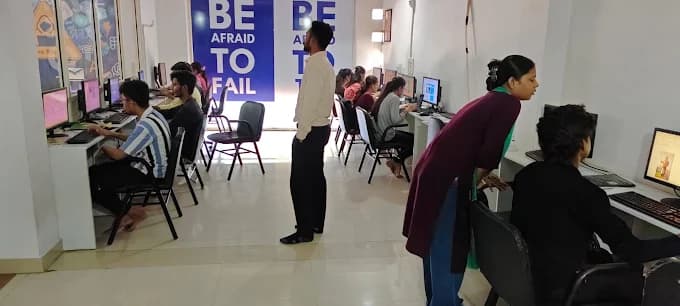
  • CEC Vatva opposite Kashiben Hospital near Vatva Lake Garden
  • CEC Vatva computer lab

Who learns AI with us around Vatva

School learners of any grade start with counseling first. After 10th or 12th, anyone can apply. These are the three groups we meet most at this centre.

  • After 12th

    Any stream, pass or fail, or after a gap year. We start with foundations and do not assume maths beyond what we teach you in class.

  • In college

    If your degree mentions AI but your labs never reached a real dataset, you practise here around your timetable.

  • Changing careers

    If you already work around Vatva, Narol, or Ramol and want to move into data or AI work, we start from what you know and fill the gaps.

Already know your starting point? Open the page written for it

Courses behind this learning

Real programmes from our catalogue. Counseling tells you which one matches where you are now.

Our Ahmedabad centres

Vatva is the closest centre for this page. Maninagar and Nikol teach the same AI learning if either is easier to reach. Anyone, anywhere, can start with a call, WhatsApp, or email.

Questions Vatva learners ask about AI

If yours is not here, ask it on a call — we would rather answer it before you join than after.

  • Where can I learn AI in Vatva?

    Computer Education And Cybernetics (CEC) teaches AI at 1st Floor, Computer Education And Cybernetics, Opposite Kashiben Hospital Beside Khodiayar Vav, Near Vatva Lake Garden, Vinzol Crossing Rd, Deriya Para, Vatva, Ahmedabad, Gujarat 382440. The landmark is Near Vatva Lake Garden; opposite Kashiben Hospital. You can call or WhatsApp +91 91571 90839 before coming.

  • How does a machine-learning model actually learn?

    It is shown past examples where the answer is already known and adjusts its internal rules until its guesses match those answers as closely as possible. You then test it on examples it never saw. Its score on those hidden examples, not on the ones it learnt from, tells you how far to trust it.

  • Do I need to know coding or advanced maths to start?

    No. If Python is new to you, counseling plans foundations first, and we teach the maths you need as it comes up in practice. What you do need is a few regular hours every week, because AI is learnt by repeating, checking, and correcting.

  • Can I fit AI classes around a work shift or college?

    Usually, yes. Our Vatva centre is open Mon – Sat: 8:00 AM – 8:15 PM; Sun: 10:00 AM – 6:00 PM. Tell us your shift or college timing in counseling and we will suggest a batch inside those hours.

  • Who teaches AI at CEC Vatva?

    Our Vatva faculty record lists Priya Shrivas, Senior Software Faculty (CCC, Tally Prime, Prompt Engineering); Suhani Kushwaha, Software Faculty (Data Analytics, Data Science, AI/ML). They are part of our team of 25+ full-time corporate trainers across our three Ahmedabad centres.

  • Will AI tools make these skills unnecessary?

    They change the work rather than remove it. Assistants now draft code and many tasks start with a ready-made language model, but someone still has to clean the data, test the output on fair examples, and explain the limits. That checking skill is what we train most.

  • How do you help me on the AI path at the Vatva centre?

    We begin with counseling, then you practise on data, train and test simple models, and use generative AI with a review log. A mentor reviews your notebook, test score, and written limits at each step, and you leave with a project you can explain in an interview.

  • Do I have to visit the Vatva centre before joining?

    No. Counseling by call, WhatsApp, or email covers the same questions, and people outside Ahmedabad can contact us the same way. If you live nearby and want to see the lab first, you are welcome to visit — it is optional.

  • How is this page different from your other Vatva AI pages?

    This page explains how AI learning works at our Vatva centre for anyone nearby. Our after-12th-science page, BCA page, and Python AI development page in Vatva are written for those specific starting points, so open the one that matches you.

  • Will you help me find a job after the AI course?

    We stay with you until you get a job, based on your performance in training, projects, and interviews. That means a role-focused resume built around your project, mock interviews with honest feedback, and guidance on which openings match what you have built.

Learn AI you can test, not just use

Tell us your shift or college timing and what you want to do with AI. We will plan a batch at our Vatva centre — or start you by phone if visiting is not practical.

Or reach our Vatva center directly

+91 91571 90839 · info@cecyours.org