AI Course in Maninagar, Ahmedabad

You know AI matters, but “learn AI” can mean four very different kinds of work. This page shows how each one works, the same small task done all four ways, and where each is heading — so you can see which one fits you. Then we match a direction to your background and your weekly hours, and practise it with you. Our centre is about two minutes from Maninagar Railway Station. Counseling comes first, at the centre — we warmly welcome you and your parents to visit before admission.

Or reach us directly

+91 75740 10176 · info@cecyours.org

Four AI directions — which sounds like you?

  • Machine learning and data

    You make: A model that predicts from past data

    Suits you if: you like numbers, patience, and finding out why something happened

  • AI development with APIs

    You make: A program that calls an AI model

    Suits you if: you enjoy building things and fixing them when they break

  • Generative AI and prompting

    You make: Reliable drafts from a language model

    Suits you if: you write clearly and notice when something sounds right but is wrong

  • AI automation

    You make: A flow that runs repeating work

    Suits you if: you think in steps and like removing repeated effort

Shared start
Computer and Python basics
Decides fit
Background + weekly hours
Every direction ends in
One project you can explain
First step
A counseling conversation

How does each AI direction actually work?

All four use AI, but the work you do each day is different. One trains a model from data; one writes code that calls a model; one controls a model through instructions; one connects AI steps into a process. Here is the mechanism behind each, side by side.

Practical AI work falls into four directions. Machine learning trains a model on labelled past data and tests it on held-back rows. AI development calls a ready-made model through an API and validates its reply in code. Generative AI and prompting control a language model through tested instructions and review. Automation chains a trigger, an AI step, and a human approval into a repeating process. At Computer Education And Cybernetics (CEC), learners build shared Python foundations, compare the four, and then practise one with mentor review.

  • Machine learning and data

    You teach a program to find a pattern in past records where the answer is already known, then use that pattern on new records.

    How the work happens
    You clean a table, mark the column you want to predict (the label), train a model on most rows, and test it on rows you held back. The held-back score tells you how far to trust it.
    What you produce
    A tested model, a score on unseen data, and a note on its limits
    Where you start
    Python basics, spreadsheets, simple statistics
  • AI development with APIs

    You write software that sends text to a ready-made AI model and uses the reply inside an application.

    How the work happens
    An API (application programming interface) is a doorway your Python code uses to send a request to a model and receive an answer. You ask for the answer in a fixed shape such as JSON — a structured text format — then your code checks it, retries on failure, and saves the result.
    What you produce
    A working script or small app, with error handling and logs
    Where you start
    Python, then requests, JSON, and basic web concepts
  • Generative AI and prompting

    You use large language models to draft text, summaries, and replies, and you control the quality through how you instruct and review them.

    How the work happens
    A prompt is the instruction you give the model. You add context, rules, and a couple of examples, read the output against those rules, then revise the prompt and keep versions so you know which change fixed which mistake.
    What you produce
    A tested prompt, approved outputs, and a revision log
    Where you start
    Clear writing, computer basics, careful reading
  • AI automation

    You connect steps — a trigger, an AI decision, an action — so repeating desk work runs with a person checking the risky parts.

    How the work happens
    A trigger starts the flow (a new message, a new file). An AI step classifies or drafts. Rules decide what happens next, and a human approval step catches anything the AI is unsure about or anything costly to get wrong.
    What you produce
    A mapped process, a running flow, and its human checkpoints
    Where you start
    Knowing how a real process works, spreadsheets, logic

Your practice task

Take 50 customer messages. First, label each one yourself as “price question”, “repair status” or “complaint” — that is the labelling step machine learning depends on. Then write a prompt that asks a language model to label the same 50. Count where you and the model disagree and write one line on why. We sit with you through this, because seeing the two methods disagree on the same data teaches the difference faster than any definition.

What you can do after one direction, honestly

You can build one small, working piece in your direction — a tested model, a script that calls a model safely, a prompt set with a review log, or a flow with a human checkpoint — and explain its limits to someone non-technical. Large production systems, training big models, and company-wide automation take more practice and usually grow on the job.

One task, four ways: sorting 300 customer enquiries

The clearest way to compare the directions is to give them the same problem. This is the shape of an exercise we use; practice files change between batches, but the thinking does not.

The input, for all four

A small electronics repair shop shares 300 past WhatsApp enquiries in a spreadsheet: the date, the message text, and whether the customer later came in.

  • Machine learning and data

    1. 1

      What you look at

      You find 12 duplicate messages and remove them, leaving 288. The came-in column is your label. Messages asking about price or same-day repair visit more often.

    2. 2

      What it produces

      You train a simple text model on 230 rows and hold back 58. It predicts 41 of the 58 correctly — about 71 percent.

    3. 3

      The decision

      Good enough to decide who gets a follow-up call first. Not good enough to ignore anyone.

    4. 4

      What you write down

      Rows removed and why, the held-back score, and one limit: Gujarati typed in English letters was often misread.

  • AI development with APIs

    1. 1

      What you look at

      Your Python script sends each message to a language model through an API and asks for JSON with two fields: category and urgency. You check whether every reply has both fields.

    2. 2

      What it produces

      291 replies arrive in the right shape. 9 break the format, so the script retries once and then flags them for a person.

    3. 3

      The decision

      The categorised sheet is usable. Flagged rows go to a human instead of being guessed.

    4. 4

      What you write down

      The prompt version, the model used, how many rows failed, and what the retry did.

  • Generative AI and prompting

    1. 1

      What you look at

      You write a prompt to draft replies for the three most common enquiry types, including the shop's real rules: opening hours, no home visits, price only after inspection.

    2. 2

      What it produces

      The first draft promises a fixed price — breaking a rule. You add the rule plainly and two example replies, and the next drafts follow it.

    3. 3

      The decision

      Three reply templates the owner reads and approves before anyone uses them.

    4. 4

      What you write down

      Each prompt version and the rule each revision fixed.

  • AI automation

    1. 1

      What you look at

      You map what happens to a new message today, step by step, and mark which steps are safe to automate and which are not.

    2. 2

      What it produces

      New message → AI sorts it → price questions get an approved template → complaints go straight to the owner with no automatic reply.

    3. 3

      The decision

      Automatic replies only use approved templates. Anything the AI is unsure about waits for the owner.

    4. 4

      What you write down

      A one-page flow map showing the human checkpoint and what happens when the AI is unsure.

Notice what all four write down: what went wrong and what the AI could not see. That habit — not the tool — is what an employer checks first, whichever direction you choose.

Where is each AI direction heading?

Each direction is already changing in a specific way. In every case, the part that stays valuable is the part a person has to check — which is why we practise it with you from the first week, not only at the end.

  • Machine learning and data

    What is changing

    Assistants now draft the Python for cleaning and training, and many problems start from a pre-trained model instead of a new one.

    What stays valuable

    Cleaning data and testing fairly on held-back rows. A drafted notebook with a leaked test set still gives a fake score.

  • AI development with APIs

    What is changing

    Models can now return structured output that code can check, and providers retire model versions regularly.

    What stays valuable

    Validating every reply, handling failures, and logging what was sent and received — so a model change does not silently break your app.

  • Generative AI and prompting

    What is changing

    Models now read much longer documents and images, and prompting is moving from clever phrasing to clear instructions with examples and review rules.

    What stays valuable

    Writing a precise brief and checking facts against the source. Longer inputs make confident mistakes harder to spot, not easier.

  • AI automation

    What is changing

    AI steps are being chained into longer flows, and some tools let the AI take actions itself, such as sending or updating records.

    What stays valuable

    Mapping the real process and deciding where a person must approve. The more a flow can act, the more that checkpoint matters.

Where AI still fails, in all four

  • It invents facts, names, and numbers and states them confidently
  • It cannot see context nobody recorded — a phone call, a local rule, a customer's history
  • It repeats patterns from old data after the situation has changed
  • It follows a badly written instruction exactly, mistakes included

The skill that outlasts any tool

Describing a task precisely enough that someone — a person or a model — can be checked against it. A clear label definition, a strict JSON shape, a prompt with written rules, a flow with a named approval step: each is the same skill in a different form. In practice we make you write that brief before you touch the tool, then test the result against it.

Across machine learning, AI development, generative AI, and AI automation, the visible shift is from writing every step by hand to briefing and reviewing AI that drafts code, returns structured answers, and takes actions in longer flows. What keeps its value is a precise brief and a check against evidence. Computer Education And Cybernetics trains both habits in every AI direction at its Maninagar, Nikol, and Vatva centres in Ahmedabad.

How we match a direction to your background and weekly hours

We do not ask you to pick a direction from a brochure. About 80% of our training is practical, so the choice is made on what you actually do in the lab, guided by two honest questions: where are you starting from, and how many hours can you keep giving every week?

Just finished 12th, any stream

We usually start with computer and Python foundations, then let you try a small task in two directions before you commit. Commerce and arts learners often take to generative AI or automation first; science learners often lean towards data.

In college — BCA, BSc IT, engineering, or a non-IT degree

We check what your syllabus already covered. If you can code, AI development with APIs or machine learning builds on it directly. If your degree is non-IT, we fill the gaps first and do not assume anything.

Working and planning a switch

We start from the work you already know. Someone in accounts or operations often sees automation chances immediately; someone who writes or handles customers often fits generative AI. Your experience becomes your first project idea.

  • A few hours a week

    Generative AI and automation usually show a useful result sooner with less code. We still build the foundations, just at a pace you can keep.

  • Steady practice most days

    Machine learning and AI development reward this, because Python, data handling, and testing build on each other week after week.

School learners of any grade start with counseling first. After 10th or 12th, anyone can apply — pass, fail, a gap year, any stream.

What happens after you choose

  1. 1

    Counseling and a skill-gap check

    We ask what you studied, what work you do or want, and how many hours you can really give each week. Then we check what you already know so we neither repeat it nor skip something you need.

  2. 2

    Foundations every direction shares

    Computer confidence, Python basics, handling a spreadsheet or file, and the habit of checking AI output before trusting it. All four directions stand on this.

  3. 3

    A short trial in two directions

    Before you commit, you do a first-step task like the repair-shop exercise in two directions. Which one you want to keep working on is better evidence than any guess made on day one.

  4. 4

    Deep practice with mentor review

    In your chosen direction, a mentor reviews your notebook, script, prompt log, or flow map — not only the final answer — and walks you through what went wrong instead of fixing it for you.

  5. 5

    One project you can explain

    You leave with notes, a finished project, and a short write-up of what it does and cannot do. That project becomes the centre of your resume, portfolio, and mock interviews.

At Computer Education And Cybernetics (CEC), choosing an AI direction follows a set order: counseling and a skill-gap check, shared Python and data foundations, a short first-step trial in two directions, then deep practice in one — machine learning, AI development with APIs, generative AI, or AI automation — with a mentor reviewing the notebook, script, prompt log, or flow map. The learner finishes with a project and a written note on its limits, used for resume, portfolio, and mock interviews.

Already know your starting point? Open the page written for it

Placement support and certificates

Each direction leads to different openings, so your preparation is built around the project you made, and we connect you with our network of 600+ hiring companies when your work is ready to show.

How we stay with you

  • We stay with you until you get a job, based on your performance in training, projects, and interviews
  • Your direction's project and its write-up become the centre of a role-focused resume and portfolio
  • Mock interviews ask you to explain your own work — the score, the failures, the limits
  • Course completion certificates are issued after you finish the practical requirements

More detail on placement support at CEC.

Learners from our Maninagar centre

  • Akash Bhavsar

    Data Science & AI with Python Course

    Data Scientist · Bacancy

  • Harshita Rajpoot

    AI Development using Python Course

    AI Generalist Intern · Mediscribe Inc.

From our recorded outcomes for AI and data science courses at this centre. Your own result depends on your work.

Common mistakes when choosing an AI direction

Most wrong choices come from deciding too fast or on the wrong evidence. These are the four we see most in counseling.

  • Choosing the direction with the loudest headlines

    A direction you do not enjoy practising is one you will stop practising. Try the first-step task before deciding.

  • Skipping foundations because an assistant writes code

    If you cannot read the code or the data, you cannot tell when the assistant is wrong. Every direction needs that reading skill.

  • Planning more weekly hours than you really have

    Be honest in counseling. A smaller, steady plan finishes; an ambitious one you cannot keep does not.

  • Thinking you can never switch

    Python, data handling, and checking output carry across all four. Many learners move from generative AI into development, or from data into automation, later on.

Programmes behind these directions

Real programmes from our catalogue. Counseling tells you which one matches the direction you choose.

Reaching our Maninagar centre from the railway station

About 2 minutes from Maninagar Railway Station, on the second floor of Gopal Tower. For classroom admission, we warmly invite you and your parents to visit, meet the mentors and see the lab before you decide. Learning from outside Ahmedabad? Counseling happens on a call, and admission is completed online.

Getting here

Come by train to Maninagar Railway Station — the centre is on the station road. BRTS, AMTS buses also serve the area.

Open hours

  • Mon – Sat: 8:45 AM – 7:15 PM
  • Sun: 10:00 AM – 6:00 PM

Learners come from

  • Kankaria
  • Isanpur
  • Ghodasar
  • Khokhra
  • Meghaninagar
  • Danilimda
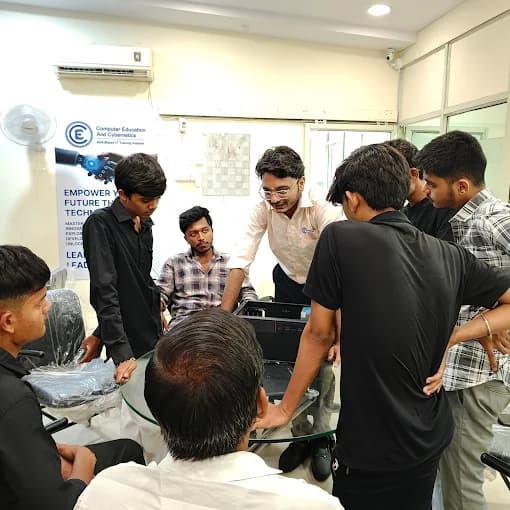
  • CEC Maninagar at Gopal Tower near Maninagar Railway Station
  • CEC Maninagar computer lab

Faculty you may learn with here

Between them, our faculty at this centre cover machine learning, artificial intelligence, data science, data analytics, MERN, and prompt engineering — so every direction on this page has someone who teaches it. They are part of our 25+ full-time corporate trainers.

  • Shilpi Sharma

    Software Faculty · 2+ years

    Teaches: CCC, Tally Prime, Prompt Engineering

  • Tanvi Darji

    Software Faculty

    Teaches: MERN Stack Development, Data Science, Machine Learning, Artificial Intelligence

  • Nayan Nathani

    Software Faculty · 2+ years

    Teaches: Data Analytics, Cyber Security

Our Ahmedabad centres

Maninagar is the centre for this page. Nikol and Vatva teach the same AI directions if either is easier to reach. Whichever centre you choose, admission starts with a short visit — parents are always welcome; call, WhatsApp, or email us to book a time. Outside Ahmedabad? We offer online admission with a counseling call.

Questions about choosing an AI direction

If yours is not here, ask it on a call — we would rather answer it before you choose than after.

  • What are the four AI directions you teach?

    Machine learning and data, AI development with APIs, generative AI and prompting, and AI automation. They share foundations — computer basics, Python, and checking AI output — but differ in what you produce: a tested model, a working program, reliable drafts, or a running flow with human checkpoints.

  • How does each AI direction actually work?

    Machine learning trains a model on past labelled data and tests it on rows held back. AI development sends requests to a ready-made model through an API and validates the reply in code. Generative AI controls a language model through tested prompts and review. Automation chains a trigger, an AI step, and a human approval into a repeating process.

  • Which AI direction should I choose if I am not sure?

    Do not choose on day one. We start with shared foundations, then you try a first-step task in two directions and keep the one you want to practise more. Counseling then checks that choice against your background and the hours you can give each week.

  • Do I need coding, maths, or lots of free time to start?

    No coding is needed to begin; we teach Python from the basics. Machine learning uses some maths, which we teach as it comes up. Hours matter more: with only a few hours a week, generative AI or automation often shows results sooner, while machine learning and AI development reward steady practice.

  • Will AI tools replace these directions in a few years?

    They are changing the work, not removing it. Assistants draft code, models return structured output, and flows can take actions, but someone still has to brief the AI precisely, check the result against evidence, and decide where a person must approve. That skill is the one we train in every direction.

  • How do you help me choose and practise my AI direction?

    We begin with counseling and a skill-gap check, build shared foundations, and let you try two directions before you commit. In your chosen direction, a mentor reviews your notebook, script, prompt log, or flow map at each step, and you finish with a project and write-up you can explain in interviews.

  • Can I switch to a different AI direction later?

    Yes. Python, data handling, and the habit of checking output carry across all four, so switching builds on what you already know. Tell your mentor early and we adjust your practice plan.

  • Will you help me find a job after the AI course?

    We stay with you until you get a job, based on your performance in training, projects, and interviews. That means a role-focused resume built around your project, mock interviews with honest feedback, and guidance on openings that match the direction you practised.

  • Where is the CEC Maninagar centre, and do I need to visit before admission?

    Computer Education And Cybernetics (CEC) Maninagar is at 2nd floor, Gopal Tower, Computer Education And Cybernetics, near Maninagar Railway Station Road, Maninagar, Ahmedabad, Gujarat 380008, about 2 minutes from Maninagar Railway Station. For classroom admission, yes — and we would be glad to welcome you. Come with your parents, meet our mentors and staff, see the lab and how classes run, and ask your questions face to face before you decide. Call or WhatsApp +91 75740 10176 to book a convenient time. If Nikol or Vatva is closer, we will welcome you there instead. Learning from outside Ahmedabad? We offer online admission with a counseling call, so no travel is needed.

  • Who teaches AI at CEC Maninagar?

    Our Maninagar faculty record lists Shilpi Sharma, Software Faculty (CCC, Tally Prime, Prompt Engineering); Tanvi Darji, Software Faculty (MERN Stack Development, Data Science, Machine Learning, Artificial Intelligence); Nayan Nathani, Software Faculty (Data Analytics, Cyber Security). They are part of our 25+ full-time corporate trainers across our three Ahmedabad centres.

Choose your AI direction with evidence, not guesswork

Tell us your background and the hours you can give each week. We will help you compare the four directions and start practising the one that fits. We would be glad to welcome you and your parents at our Maninagar centre. If you are outside Ahmedabad, we guide you on a counseling call and complete your admission online.

Or reach us directly

+91 75740 10176 · info@cecyours.org